Answer first
RAG is not a charting method, dashboard framework, BI layer, or visualization technique. RAG is a pattern for retrieving external context and using it to ground generated language.
RAG Started as a Knowledge Retrieval Pattern
Retrieval-augmented generation, or RAG, is a way to improve a model's generated answer by retrieving relevant external information and passing that information into the generation step.
The canonical 2020 paper, Retrieval-Augmented Generation for Knowledge-Intensive NLP Tasks, framed RAG around knowledge-intensive natural language tasks. It combined parametric memory, what the model learned during training, with non-parametric memory, an external corpus retrieved at inference time.
In plain English:
- Find relevant context.
- Give that context to the model.
- Generate an answer grounded in the retrieved material.
That is the core idea. Everything else is implementation detail.
Is RAG Related to Data Visualization?
Not directly.
Data visualization is about querying, aggregating, and presenting data visually. RAG is about retrieving external context to ground a language model's generated answer.
They can meet in analytics assistants, but they solve different problems.
| Task | Is it RAG? | Why |
|---|---|---|
| Draw a revenue chart from a database query | No | That is analytics and visualization. |
| Explain what "active customer" means using a metric glossary | Yes, if the glossary is retrieved | The model is grounding its language output in external context. |
| Summarize a dashboard using only the chart data already provided | Not necessarily | No separate retrieval step is required. |
| Explain a drop using release notes, incident logs, and support tickets | Potentially yes | The assistant retrieves outside context to support the explanation. |
The technically correct statement is:
RAG is not required to make dashboards. Retrieval can help an analytics assistant explain or contextualize a dashboard when relevant source documents, definitions, or operational notes live outside the chart data.
That distinction matters because every AI feature should not be labeled RAG.
The Old RAG Pattern Is Too Small
The simple RAG pattern is familiar:
Take documents. Chunk them. Embed them. Store the vectors. At question time, retrieve similar chunks and pass them to the model.
That can work for narrow use cases: a support bot over a static knowledge base, a search assistant over a few PDFs, or a documentation Q&A feature.
But it becomes too small when an organization wants AI across real workflows.
The same company might need:
- a support copilot over tickets, docs, and account data
- a sales assistant over CRM, call notes, proposals, and product pages
- an operations agent over spreadsheets, policies, and internal systems
- a research agent over web pages, docs, Slack, and analyst notes
- a compliance workflow that retrieves clauses, approvals, and audit trails
If each app builds its own RAG pipeline, you get duplicated connectors, duplicated embeddings, inconsistent access control, stale indexes, and different answers from the same source material.
The better architecture is to treat retrieval as shared infrastructure.
What Retrieval Infrastructure Means
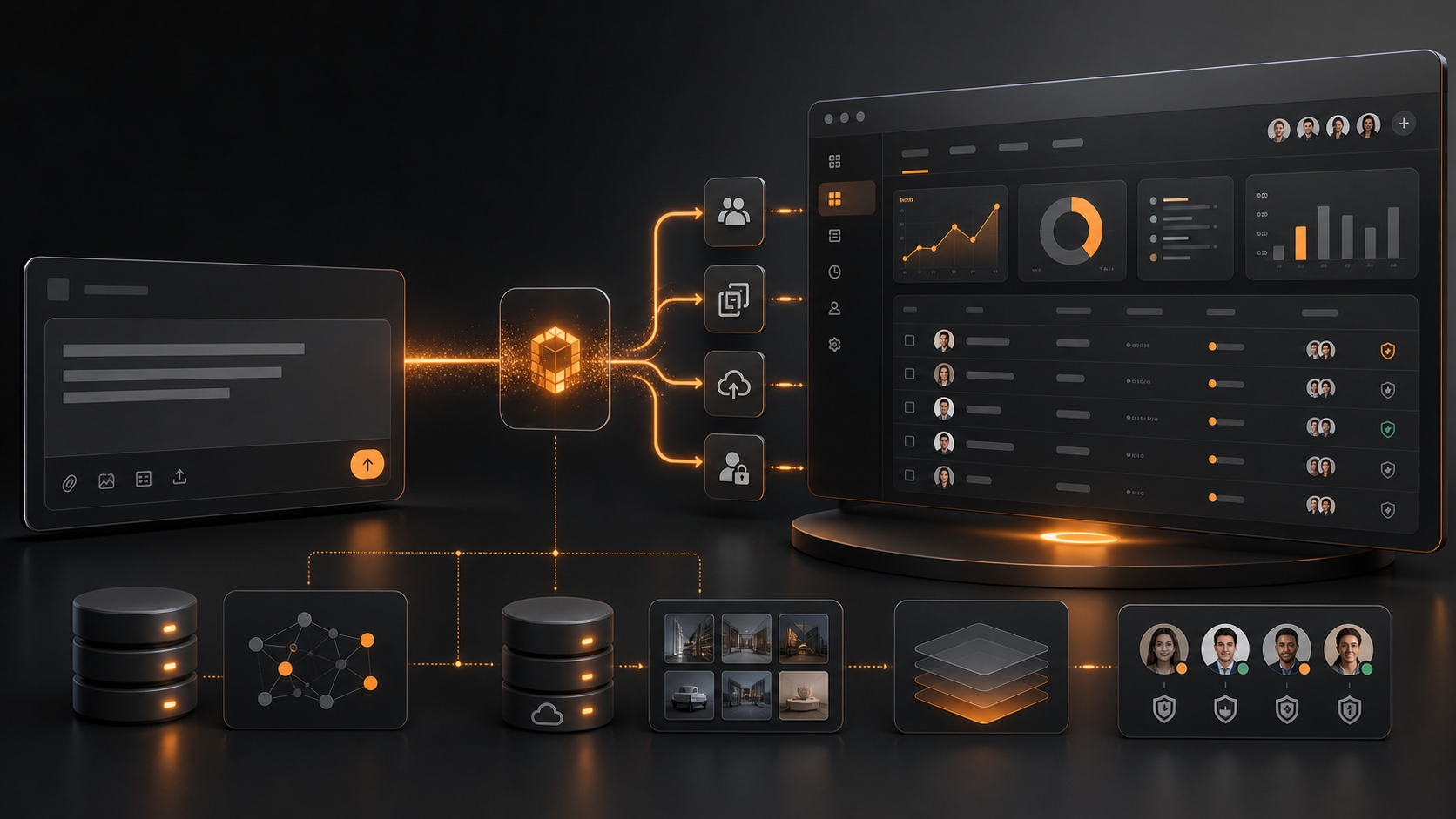
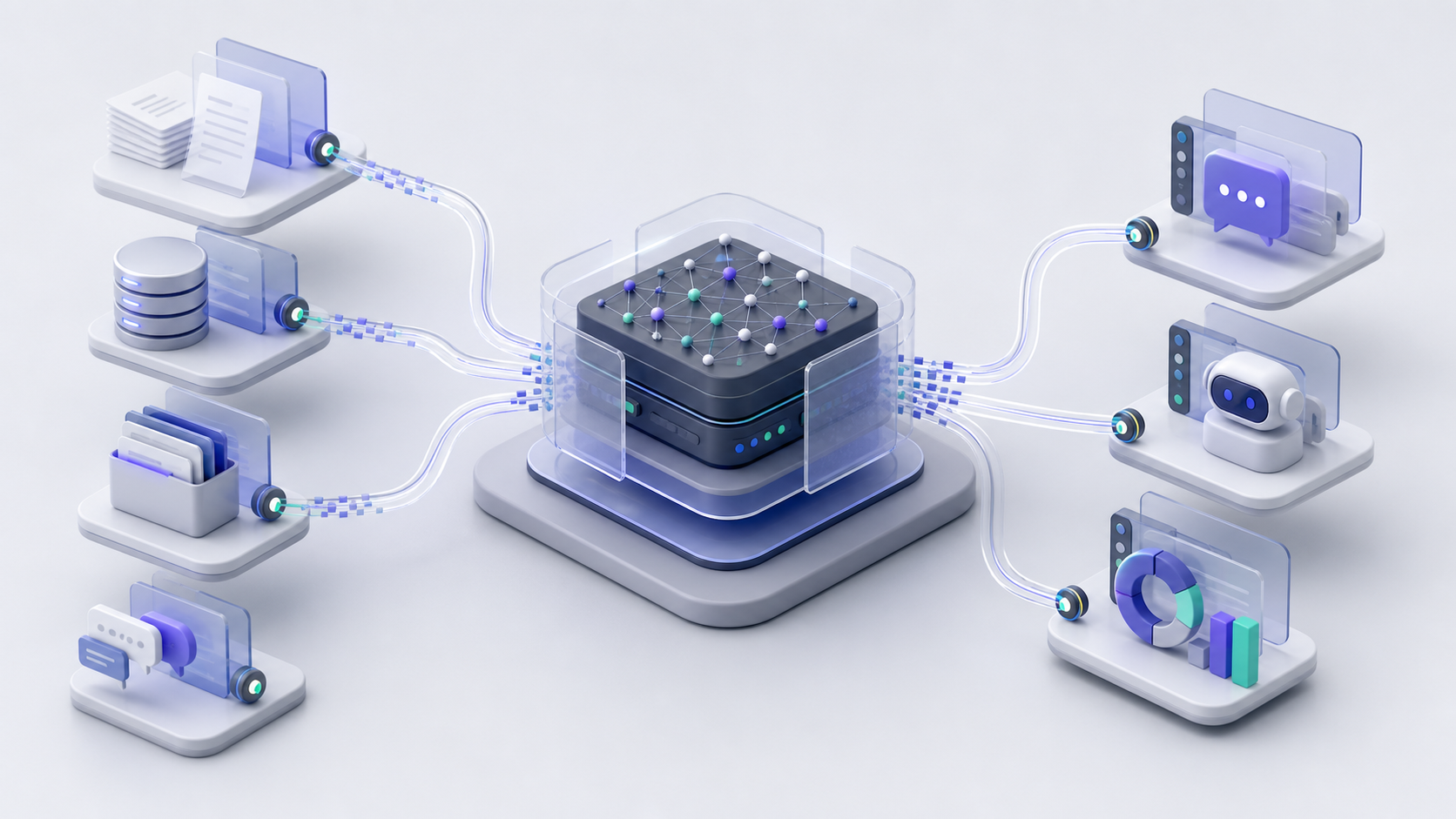
Retrieval infrastructure is a shared layer that connects to many sources, keeps them synced, indexes them, enforces access control, and exposes context through a common interface.
Instead of every app owning its own ingestion and search stack, the retrieval layer becomes a platform service.
It handles:
- source connectors
- authentication and permissions
- extraction and parsing
- chunking and metadata
- embeddings and keyword indexes
- incremental sync
- reranking
- source attribution
- query APIs
- observability
- deletion and retention
Open-source projects such as Airweave show this direction clearly. Airweave describes itself as an open-source context retrieval layer for AI agents and RAG systems. Its README says it connects to apps, tools, and databases, continuously syncs data, and exposes a unified search interface for agents.
The point is not that every team should use one specific project.
The point is that retrieval is becoming a reusable platform layer, not a one-off chatbot feature.
The RAG Suitability Test
Use RAG when all three conditions are true:
- The answer depends on information outside the model's prompt or training data.
- That information changes, is private, is too large, or needs source attribution.
- The model must generate language grounded in retrieved context.
Do not use RAG just because an LLM is involved.
| Use case | Better first architecture |
|---|---|
| Querying numerical data | SQL, semantic layer, or analytical engine |
| Generating charts | Visualization library or BI tool |
| Applying a deterministic rule | Code, validation, or rules engine |
| Answering from changing docs | RAG or search-backed generation |
| Finding relationships across entities | Graph search, knowledge graph, or GraphRAG-style retrieval |
| Choosing which sources to inspect | Agentic retrieval with explicit tools and evaluation |
Why App-Specific RAG Breaks
1. Stale Context
Documents change. CRM fields update. Policies get revised. Tickets close. Internal definitions evolve.
If your retrieval pipeline only re-indexes manually, the model may answer from old information. In some domains that is annoying. In legal, finance, healthcare, or operations, it can be dangerous.
Retrieval infrastructure needs incremental sync, source timestamps, versioning, and failed-sync visibility.
2. Duplicated Pipelines
One team builds a chatbot over docs. Another team builds an agent over the same docs. A third builds internal search over the same source.
If each system builds its own connector, parser, chunker, embedder, and permission model, maintenance becomes expensive and inconsistent.
A shared retrieval layer lets multiple AI products consume the same governed context.
3. Weak Governance
Retrieval is not only a relevance problem. It is an access problem.
If a user cannot access a document in the source system, the AI system should not retrieve it for them. If a record is deleted under a retention policy, the index should not keep answering from it. If a source is private to a department, the agent should respect that boundary.
This is hard to solve repeatedly inside every app. It belongs in shared infrastructure.
Standard RAG, Graph RAG, and Agentic Retrieval
Teams often ask whether they should build standard RAG, Graph RAG, or agentic RAG. The better question is what kind of retrieval problem they have.
Standard RAG
Use this when the answer is likely contained in a small number of directly relevant text chunks.
Example: "What is the refund policy for enterprise customers?"
Graph RAG
Use graph-based retrieval when the answer depends on relationships across entities. Microsoft Research describes GraphRAG as combining text extraction, network analysis, LLM prompting, and summarization to understand text datasets.
Example: "Which customer accounts are affected by the service scheduled for maintenance on Friday?"
Agentic Retrieval
Use agentic retrieval when the system must decide which source to query, whether to refine the query, and whether the retrieved context is sufficient. The LlamaIndex agentic strategies documentation describes building agents on top of RAG workflows for query planning and decision-making over existing query engines.
Example: "Prepare a renewal risk brief using CRM notes, support history, recent calls, open security issues, and product usage context."
These are not maturity levels. They are retrieval modes.
What a Good Retrieval Layer Returns
A retrieval layer should return more than raw chunks.
It should expose:
- matched content
- source title
- source URL or record ID
- author or owner when available
- timestamp or version
- permission scope
- relevance score
- metadata for filtering
- citation-friendly snippets
- freshness status
For agents, the API should support structured tool use. REST is useful. MCP-style tool exposure is useful. SDKs are useful. The exact interface matters less than consistency.
The agent should not need to know how to authenticate with ten systems. It should call one governed retrieval layer and receive context it is allowed to use.
A Practical Retrieval Inventory
Before choosing a vector database, map the retrieval problem.
Start with these questions:
- Which three workflows need context first?
- Which sources do those workflows need?
- Who owns each source?
- How often does each source change?
- Which permissions must be preserved?
- What metadata is required for citations?
- What deletion and retention rules apply?
- What should happen when a sync fails?
- How will retrieval quality be evaluated?
- Which apps and agents will consume the same context layer?
Common Mistakes
Treating Embeddings as the Whole System
Embeddings are one part of retrieval. They do not solve parsing, permissions, freshness, deduplication, ranking, evaluation, or attribution.
Calling Every AI Feature RAG
An AI chart, AI workflow, or AI dashboard is not automatically RAG. It becomes RAG only when generation is grounded in retrieved external context.
Returning Context Without Citations
If the user cannot inspect the source, the answer is hard to trust. This becomes especially important in sales, legal, finance, compliance, healthcare, and operations.
Rebuilding Connectors Per App
Connectors are expensive to maintain. If several AI systems need the same sources, centralize ingestion.
Skipping Evaluation
Retrieval should be tested separately from generation. Create representative questions, expected sources, and failure cases. Track whether the right documents are retrieved before judging the model's final answer.
Primary Sources and Further Reading
- Retrieval-Augmented Generation for Knowledge-Intensive NLP Tasks, the original RAG paper.
- Airweave GitHub repository, an open-source context retrieval layer for AI agents and RAG systems.
- Microsoft Research GraphRAG for graph-based retrieval-augmented generation.
- LlamaIndex agentic strategies for agentic retrieval patterns.
The Bottom Line
RAG is no longer just a chatbot technique.
It is becoming part of the shared retrieval infrastructure behind agents, internal search, research workflows, and decision support systems.
The teams that win will stop asking "Which vector database should we use for this app?" and start asking "What context layer should every AI workflow trust?"
That is the architectural shift: retrieval moves out of the app and into the platform.